


Lisbon and the African legacy of slavery and interconnectedness

Walk along the Tagus in Lisbon and you immediately see the beautiful side of the city: lights on the water, yellow trams, squares full of people, ships in the distance. But precisely there, on that same river, lies a history that appears much less often on postcards.
For centuries, Lisbon was a gateway to Africa. From the 15th century, Portuguese ships sailed along the West African coast to islands such as Cape Verde and São Tomé, and further to Angola, Mozambique, and beyond. Those voyages brought trade, languages, food, music, and families to Portugal. They also brought violence, forced labor, and slavery.
That does not make the bond between Lisbon and Africa simple. It is a story of enormous inequality, but also of presence, survival, and influence. Anyone who looks closely will notice that African heritage in Portugal is not a footnote. It is in the neighborhoods, in street names, in churches, in markets, in music, and in the people who shape the city today.

The bond between Lisbon and Africa began at sea.
The Portuguese connection with Africa did not begin as one grand plan. It began with ships, maps, ports, and a mix of curiosity, profit motive, and power. From the 15th century onwards, Portuguese expeditions sailed ever further along the African coast. They sought gold, spices, trade routes, and political influence.
In Portuguese schoolbooks and tourist texts, you often come across the word “explorations.” That word sounds adventurous, but it tells only half the story. For the people who already lived along those coasts, those areas were, of course, not new. The arrival of Portuguese traders, soldiers, and missionaries profoundly changed existing societies.
Lisbon benefited directly from this. The city grew into an important hub in the Atlantic world. Goods arrived via the river. Money, stories, and people flowed in and out of the city. The Tagus was not just a beautiful backdrop, but an economic artery.
From Lisbon, lines ran to, among others:
The West African coast, where trading posts and contacts originated.
Cape Verde, which played a central role in Atlantic routes.
São Tomé and Príncipe, where plantation economies emerged.
Angola, which later played a major role in the forced deportation of Africans.
Brazil, where Portuguese colonial power and slavery converged on a massive scale.
These connections made Portugal richer and more powerful. They also made Lisbon more cosmopolitan. African interpreters, sailors, artisans, servants, merchants, enslaved people, and free residents came to the city.
That is precisely why Black history Lisbon is not a separate chapter alongside the “real” city history. It belongs to the heart of Lisbon itself.
Slavery was part of the ordinary life of the city.
Portugal was one of the first European countries to use African slavery on a large scale within an Atlantic colonial system. This began as early as the 15th century. Even before the plantations in Brazil were operating on a large scale, African men, women, and children were visibly present in Portuguese cities.
In Lisbon, enslaved people worked in all kinds of places. Not only in ports or on ships, but also in houses, workshops, kitchens, streets, and markets. They carried water, cooked, hauled goods, cared for children, sold products, or performed heavy artisanal work.
That sometimes makes it difficult to truly see this history. Slavery did not take place in one remote location. It was interwoven into daily city life.
Historians estimate that in the 16th century, approximately 10% of the population of Lisbon was of African descent.
That figure says a lot. Not because every life fits into a single percentage, but because it shows how normal African presence already was in the city at that time. Lisbon was not an entirely white European capital where Africa existed only in the distance. Africa was present on the streets.
Yet that presence was later often pushed into the background. The Portuguese national memory long emphasized seafaring, discoveries, and heroism. Ships, maps, and kings were given monuments. The people who were turned into commodities by those same routes were given much less space in the public narrative.
You also notice this in the way tourists often get to know the city. You hear about Vasco da Gama, about the great earthquake of 1755, about fado, tiles, and pastéis de nata. All interesting, certainly. But without slavery and colonial trade, the picture remains incomplete.
Anyone searching for Lisbon's slave trade history will soon come across places along the Tagus, old trading zones, and squares where power became visible. Not always because a clear sign still stands. Often precisely because there is so little.

Free African Lisboners are also part of this story.
When it comes to African history in Lisbon, the focus often immediately shifts to slavery. That is logical, because that history is vast and painful. But the full story is broader.
There were also many free Africans and Afro-Portuguese in the city. Some were born free. Others had bought, been given, or obtained freedom through legal and religious means. Their lives were not automatically easy. Racism, poverty, and social exclusion persisted. Nevertheless, they built communities, networks, and forms of support.
In cities such as Lisbon, religious brotherhoods played a major role. For Black residents, such brotherhoods could offer practical help, for example during illness, funerals, or financial hardship. They also provided a place of recognition and status within a society that often restricted them.
As a result, churches were not only religious spaces. They were also social places. A church could be a place where people from different African backgrounds met, made agreements, shared rituals, and cared for one another.
There is something important in that. A history of oppression is also a history of people who built relationships, made choices, brought their culture with them, and found new ways of life. If you look only at victimhood, you miss their humanity. If you leave out slavery, you make the story too slick. The truth lies in that tension.
A place that often comes up in conversations about this hidden history is Mocambo. Historically, it was an area where many people of African descent lived, outside or on the outskirts of the old city center. In the Atlantic world, the name itself is more frequently associated with Black communities, including communities of escaped enslaved people. In Lisbon, it points to a long presence that did not always fit neatly into the official city narrative.
Today, many people walk through neighborhoods like Madragoa, Santos, or around São Bento without knowing that such neighborhoods were once situated in places with a presence of African origin dating back centuries. That immediately makes walking through Lisbon different. A facade is not just a facade. A street name is not just a street name. A neighborhood can carry history layer upon layer.
The African heritage lives on in neighborhood food and music
The bond between Lisbon and Africa is not a museum piece. You can still feel it today, especially through the communities from former Portuguese colonies. Think of people and families with roots in Angola, Cape Verde, Guinea-Bissau, Mozambique, and São Tomé and Príncipe.
After decolonization in the 1970s, many people from these countries came to Portugal. Some returned from former colonies as Portuguese citizens. Others came later for study, work, family, or safety. Their presence changed the city, and at the same time made visible what had actually always been there: Lisbon is deeply connected to the Atlantic world.
You taste it in restaurants where Cape Verdean cachupa or Angolan moamba is served. You hear it in music styles like funaná, kizomba, semba, and kuduro. You see it in hair salons, cafes, small shops, and markets where products from Africa and the diaspora are sold.
And no, that does not only take place in the historic centre. Lisbon’s African heritage also lives on in the wider metropolis, in neighborhoods and suburbs where communities have built their own places. Anyone who stays only between Baixa, Alfama, and Belém misses a large part of the story.
That does not mean that, as a visitor, you should simply walk into every neighborhood as a “cultural experience” as if it were an attraction. It requires a little humility. Eat at a local restaurant, listen to music, perhaps book a walking tour with a guide who takes this history seriously, and treat places where people simply live with respect.
A few ways to experience Lisbon's African heritage more consciously:
Choose a walk that does not skip colonial history and slavery.
Visit places around the Tagus and ask who all came in via that river.
Eat at a Cape Verdean, Angolan, or Guinea-Bissau restaurant and read something about the dish beforehand.
Look beyond the well-known monuments in Belém.
Ask yourself why some stories are displayed prominently in town squares, while others are almost invisible.
For those who love Things to do in Lisbon history and culture, this is perhaps the most valuable route: no longer seeing, but looking differently.

A monument on the Tagus makes the past more visible.
Lisbon has many monuments to seafarers, kings, and national landmarks. For a long time, there was much less public space for the victims of slavery and the transatlantic slave trade.
A significant turning point occurred in 2017. At that time, residents voted via a participatory city budget for a monument commemorating the victims of slavery. The initiative stemmed from the efforts of Afro-Portuguese activists and organizations who felt that Lisbon could no longer ignore this past.
The location on or near the Tagus is symbolically strong. That river was the route of departure and arrival. It connected Lisbon with Africa, America, and Asia. It brought wealth to the city, but also people who were taken away against their will, sold, or exploited.
A monument naturally does not resolve the past. It does not change lives that have been destroyed. Nor does it automatically put an end to racism or inequality today. But public memory does do something. It determines what a city makes visible. It determines what school classes reflect on. It determines which questions tourists ask. It determines who feels recognized in the city where they live.
That is why such a monument is more than stone, metal, or design. It is a correction of silence.
Yet commemoration remains difficult. Some people fear that attention to slavery undermines national pride. Others believe that Portugal actually becomes more honest by telling the full story. Personally, I find the latter much stronger. A city does not become less beautiful if you know its difficult past. It becomes more authentic.
Praça do Comércio is a good example of this. The square is impressive, spacious, and photogenic. You feel power and grandeur there. But if you know something about Praça do Comércio's history, you also see a place that was connected to royal power, trade, and imperial imagination. Not every square needs to have a single meaning. It is precisely the combination that makes it interesting.
The same applies to Belém. Many visitors go there for the Belém Tower, the Jerónimos Palace, and the famous pastries. That is all possible. But Belém was also linked to maritime expansion, colonial wealth, and the Portuguese self-image as a seafaring nation. When you walk there, do not just look up at the monuments. Also look at what they do not tell you.
How you can follow this history yourself in Lisbon
You don't need academic knowledge to walk through Lisbon more consciously. Above all, you need to be willing to view familiar places with an additional question: who was commemorated here, and who wasn't?
Start at the Tagus. The river immediately helps you understand the city. Ships made Lisbon rich, but they also made the city part of forced migration and colonial exploitation.
Afterwards, walk through Baixa and towards the old port areas. Much was rebuilt after the earthquake of 1755, so do not expect medieval traces everywhere. Nevertheless, the city structure remains connected to trade, power, and disaster recovery.
Go to Praça do Comércio and imagine how the city presented itself to the world here. This was no ordinary square. It was a stage of power by the water.
Next, look for places that often feature in tours about Black history, such as São Domingos, Poço dos Negros, and the surroundings of old African settlements. Note: not every place has clear explanations. Sometimes you really need a guide, book, or audio tour to understand what you are seeing.
If you book a Lisbon Black history tour , choose someone who does not reduce history to a few “hidden facts.” A good guide shows connections between slavery, free Black communities, colonialism, migration, and present-day Lisbon.
You can also create a short route yourself around three questions:
Where did wealth enter the city?
Where did people of African descent live?
Where is this past commemorated?
Think of the river, harbors, trading squares, and warehouses.
Look at old neighborhoods, churches, brotherhoods, and street names.
Pay attention to monuments, plaques, museums, and especially to the voids.
That last question often lingers. For Lisbon does not have a hidden history simply because no one ever wrote about it. Much history was also actively pushed away, minimized, or embellished.
You see this often in European port cities. Amsterdam, Liverpool, Nantes, Bristol, and Cádiz all struggle with colonial memory. Lisbon fits into that list, but has its own story. Portugal was involved in African slavery early on, held onto colonial possessions for a long time, and at the same time built a national myth around seafaring and encounter.
When you know that, the city feels richer and more uncomfortable at the same time. And honestly: that is exactly what good history does.
Frequently Asked Questions
Why is African history so important to Lisbon?
Because African presence has been part of the city for centuries. Lisbon was a hub of Portuguese trade, colonialism, and slavery, but also a place where free Africans and Afro-Portuguese built communities.
Was Lisbon really involved in the slave trade?
Yes. From the 15th century onwards, Portugal played an early and major role in the trade of enslaved Africans. Lisbon was an important port city and administrative center in this context.
Where can you see this history in Lisbon?
Start at the Tagus, Praça do Comércio, Belém, and places around old neighborhoods like Mocambo and Madragoa. Churches, street names, and special walking routes can also tell a lot, although explanations are not always clearly displayed on the street.
Are there still African communities in Lisbon?
Certainly. Lisbon and the surrounding region have large communities with roots in Angola, Cape Verde, Guinea-Bissau, Mozambique, and São Tomé and Príncipe, among others. You can see and hear their influence in food, music, shops, language, and daily city life.
Has the monument for the victims of slavery been planned for a long time?
The idea received broad support in 2017 through a vote among residents of Lisbon. The monument fits into a broader movement to make the history of slavery more visible in the public space.
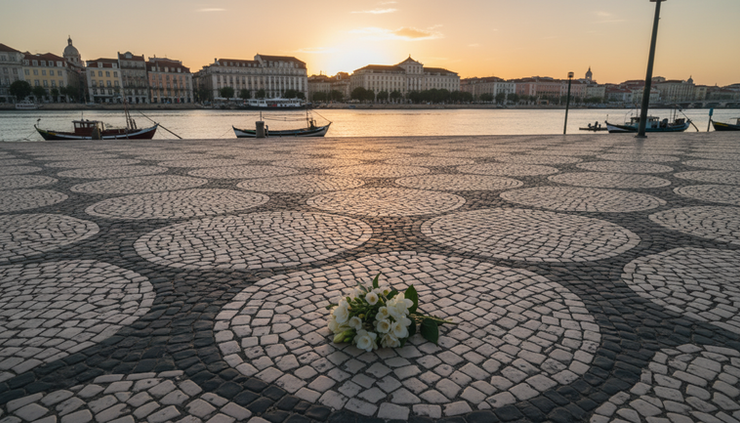
Lisbon remains a beautiful city. That does not change when you learn about its African history. The yellow trams remain yellow, the Tagus continues to sparkle, and the hills remain tough on your calves.
But the city is getting deeper.
You see that the river is not only romantic but also historically charged. You notice that colonial wealth is not separate from slavery. You understand that the African presence in Lisbon is not something new or “extra,” but an old and enduring part of the city.
And perhaps you walk a little slower afterwards. Not to enjoy less, but to look more closely.


Comments